
-
 KONGDY
Spread, Not Average: Reading the Interval Between Event and Warning Letter for a Steam Eye Mask OEM in 2026
Spread, Not Average: Reading the Interval Between Event and Warning Letter for a Steam Eye Mask OEM in 2026

Nine warning letters sit in this library, and each one has two dates in it: the event that started the process, and the date the letter was issued. The interval between them is the most neglected number in the public record.
The usual way to describe it is a range, and a range is a poor instrument here because it hides the thing that matters. What matters is not how long the process takes on average. It is how much the answer moves depending on which route produced it, because that determines whether a manufacturer can plan.
Recomputing the intervals from the dates recorded in the letters gives three groups, and the middle one is the surprise.
For a steam eye mask OEM the practical output is a rule about which route can be planned for and which cannot, and the rule turns on a statistic that a range hides.
1. The nine intervals, in order
Every figure in this article is computed from a date in the public record rather than estimated, and the table below is the whole dataset.
| Letter | Route | The event that started it | Letter dated | Days |
|---|---|---|---|---|
| 735346 | Online review | Website and storefront reviewed, July 2026 | 2026-10-01 | 92 |
| 736006 | Online review | Products purchased, July 2026 | 2026-10-01 | 92 |
| 724506 | Site inspection | Inspection ended 17 December 2025 | 2026-05-29 | 163 |
| 320-26-12 | Site inspection | Inspection ended 9 May 2025 | 2025-10-31 | 175 |
| 320-26-105 | Site inspection | Inspection ended 16 January 2026 | 2026-07-24 | 189 |
| 320-26-99 | Site inspection | Inspection ended 19 December 2025 | 2026-07-02 | 195 |
| 726976 | Site inspection | Inspection ended 15 January 2026 | 2026-07-31 | 197 |
| 718720 | Online review | Labelling reviewed 15 April 2025 | 2025-11-12 | 211 |
| 707956 | Records request | Records request sent 4 September 2024 | 2025-08-11 | 341 |
The table is sorted by interval, and the shape of it is the finding. The five inspection cases sit between 163 and 197 days with nothing else between them, and the online review cases sit at one end and the other end of the whole range.
2. The middle group is the tightest
The five site inspection cases run from 163 to 197 days, a spread of 34 days, and that is the tightest group in the dataset by a wide margin.
| Statistic | Site inspection | Online review | Records request |
|---|---|---|---|
| Cases | 5 | 3 | 1 |
| Shortest | 163 days | 92 days | 341 days |
| Median | 189 days | 92 days | Not stated for a single case |
| Longest | 197 days | 211 days | 341 days |
| Spread | 34 days | 119 days | Not applicable |
| Mean | 184 days | 132 days | 341 days |
The fourth row is the one the whole article turns on. Thirty-four days against 119 days is not a small difference, and it is the difference between a process that can be planned for and one that cannot.
The fifth row is the trap, and it is worth naming because it is the number most people would quote. The mean of the online review cases, 132 days, is lower than the mean of the inspection cases, and a reader who used it would conclude that reviews are faster. The median of the same three cases is 92 days, and the longest is 211, so the mean is describing a case that is not typical of the route.
For a steam eye mask OEM the difference between those two statistics is the difference between a supplier who knows what to expect and one who is surprised in either direction.

3. Why the inspection route is so consistent
The consistency is not a coincidence and it is not a policy. It follows from what the route actually is.
An inspection has a fixed shape. The visit happens, the observations are made, a Form FDA 483 is issued, the firm responds, and the agency decides whether to issue a letter. The five intervals in this library are all close to six months, and the variation between them is the variation in how quickly a particular firm answered and how quickly a particular agency reviewed.
| What the inspection route standardises | What it leaves variable |
|---|---|
| The starting point, which is a fixed event with a recorded end date | How long the firm takes to respond, which is not set by the agency |
| The evidence, which is observation plus records | How long the agency takes to assess the response |
| The finding types, which are the clauses of Part 211 | How many findings, which varies with what the inspector saw |
| The letter structure, which is the same in each case | Whether a letter follows at all |
The fourth row is worth pausing on, because it is the point where the two routes diverge most sharply. The clock is consistent only when it runs, and on the inspection route it usually runs.
For a steam eye mask OEM that is the good news: an inspection case is a calendar event with a known horizon, and a firm that has its documentation ready has time to use it.

4. Why the review route is not
The online review route spans 119 days across three cases, and the reason is visible in what the three cases actually were.
| Case | What was reviewed | Days | What differs |
|---|---|---|---|
| 735346 | A website and an Amazon storefront | 92 | The review month and the letter date are both fixed, and the firm was a maker rather than a platform |
| 736006 | Products bought on a website | 92 | The same review month and letter date, and the recipient was a platform rather than a maker |
| 718720 | A labelling, a website and two social accounts | 211 | A different review month by seven months, and a firm in another country |
The third row is the case that changes the reading, and it changes it twice. Its start date is eight months earlier than the other two, which means it was reviewed first and published last, and its interval is the longest in the review group.
The two 92-day cases share a review month and a letter date, so they are close to one observation recorded twice rather than two independent measurements. The 211 days is the only case that shows the route taking longer, and it is also the only case where the review was of a labelling rather than of a storefront.
A steam eye mask OEM should read that as a caution about the online review figure rather than as a finding about the route. A 92-day review is the fast case, and the fast case is the one where the review happened in a month the letter was published in.

5. The longest interval belongs to the route with no threshold
The records request took 341 days, and it is the only case of its route, so it cannot be turned into a distribution. What it can be turned into is a comparison.
| Route | What has to happen before it can be used | Longest interval here |
|---|---|---|
| Site inspection | An inspection has to be scheduled and conducted | 197 days |
| Online review | Something has to be published that can be read or bought | 211 days |
| Records request | Nothing. It is a letter | 341 days |
The third row of the third column is the interesting one, because the longest interval belongs to the route with the lowest entry requirement. That combination is what makes the route dangerous rather than merely slow.
The case that produced it makes the point sharply. The firm told the agency it tested every batch before release, the agency asked for the test data, and the firm could not provide any records demonstrating that it tested its finished products before release. Nothing was inspected and nothing was observed, and a conclusion was reached entirely from what was absent.
For a steam eye mask OEM the practical reading is that the route with the longest clock is also the one that arrives without warning, and that the response it needs is the same response a buyer would need: a record that can be produced the same day.

6. The second clock in the same story
The interval discussed so far runs from an event to a letter. A second interval runs from a letter to a published entry, and it is much shorter and much less consistent.
Measured on 11 November 2026 across a sample of a hundred consecutive entries published in the register between 29 September and 10 November, the gap between the date printed on a letter and the date it appeared in the register had a median of 14 days and a maximum of 239 days, with 70 of the 100 at 8 days or less.
| Clock | What it measures | The figures |
|---|---|---|
| Event to letter | How long the agency took to reach a conclusion | 163 to 341 days across nine cases |
| Letter to publication | How long the register took to show a letter that had been decided | Median 14 days, maximum 239 days, 70 of 100 within 8 days |
The two rows are worth reading together, because they explain each other. A letter that took six months to decide may appear on the register two hundred days later or eight days later, and a reader who watches the register sees the second interval rather than the first.
For a steam eye mask OEM that means the register is not a place to measure enforcement speed, and a steam eye mask OEM that watches it weekly will see a step in the count when a batch of letters is published rather than when anything happened.

7. What to do with two clocks
Four steps, and the first is the one that matters most.
- Plan against the route you can predict. For an inspection route, the five cases in this library cluster within 34 days, so a firm can put a date in a diary and work back from it.
- Do not plan against the mean of a small group. The online review mean of 132 days describes a case that is not typical of the route, and a firm that planned against it would be wrong in both directions.
- Prepare for the route that arrives without warning. A records request needs no visit and no prior sign, so the only preparation is to have the records ready.
- Read the register for names and clauses, not for speed. The interval from issue to publication is a publication process and says nothing about how long the agency took.
The third step is the one a steam eye mask OEM is most likely to skip, because it requires no action to look prepared for. What it requires is one batch, one folder and one person who can send it, and the case that produced the longest interval in this dataset would have been prevented by exactly that.
A steam eye mask OEM that has done that has also done the preparation that the other two routes need, because the records are the same records.

8. Nine cases, and what the set can bear
Any dataset of nine cases needs its limits stated, and this one has three that matter.
| The limit | What it affects | How it was handled |
|---|---|---|
| The cases are selected, not sampled | The absolute rates cannot be generalised to all letters | The comparison between routes was used rather than any absolute rate, because a route property survives selection better than a population figure does |
| Two of the three review cases share a review month and a letter date | The 92-day figure is close to one observation recorded twice | The 92 days was labelled as the fast case rather than as the typical one |
| The records request route has one case | No distribution, median or spread can be stated for it | The 341 days was reported as a single case figure and compared on the threshold argument rather than on the interval |
The first row is the one that determines how the article should be used. These nine letters were selected because they were rich enough to teach something, and a selection made on richness will skew towards findings.
That objection does real damage to any statement of the form "FDA takes about six months to issue a letter". It does no damage to a statement of the form "an inspection case is predictable in a way that a review case is not", because that is a statement about the instruments rather than about the population.
There is a second reason the selection does not matter as much as it appears to. The three routes have different starting conditions, and that is visible in the letters themselves rather than inferred from them. An inspection letter states what investigators observed. A review letter states what was reviewed or bought. A records request letter states the date the request was sent and refers to the records the firm produced in response. A reader can classify a letter into one of the three by reading how it begins, and that is a property of the letter rather than of the sample.
That is also why the comparison is worth making at all. A firm that has never been inspected can still recognise a records request when it arrives, because the letter says so in its first paragraph. A steam eye mask OEM that has prepared against the instrument has prepared against something it can recognise, and a steam eye mask OEM that has only prepared against a feeling about what an inspection looks like has prepared against something it cannot recognise in advance.
The third row of the limits table, the single records request case, is the easiest to state and the hardest to improve on without new data. One case supports a statement about the threshold for that route and nothing about its typical duration, and a steam eye mask OEM that quotes the 341 days should say so every time it quotes it.
A steam eye mask OEM that quotes every figure in this article with its sample attached is doing better than a steam eye mask OEM that quotes the shortest interval in the table as though it were a service standard.
There is a closing observation that belongs with the numbers rather than with the advice. The route with the tightest interval is the one that required a factory, a scheduled visit and a set of observations. The route with the widest interval is the one that required a letter and a reply. The enforcement effort the agency spends is not visible in the interval, and the interval measures how long the agency took to decide rather than how much work it did.
For a steam eye mask OEM the consequence is that a short interval does not mean a small matter, and the two cases in this library with the shortest intervals are among the most serious findings in the set. A steam eye mask OEM that has planned around the idea that speed indicates severity has the logic exactly backwards, and the 92-day cases are where that reversal becomes visible. A steam eye mask OEM that plans on the same basis has learned the wrong lesson from the same table.
About KONGDY Medical

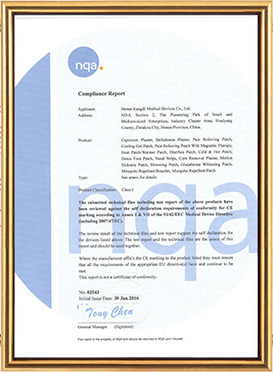
Henan Kongdy Medical Devices Co., LTD. (KONGDY) was founded in 1989 and has 37 years of production experience as of 2026 across pain relief patches, slimming patches, capsicum plasters, heat patches, cooling gel patches, detox foot patches, steam eye masks, mosquito repellent patches and nose strips. Headquartered in Henan, China, KONGDY operates a 100,000-class GMP workshop built in 2008 and obtained ISO 13485 medical device Quality Management System European Standard Certification in 2014. The company runs OEM and ODM services for international brands across multiple regulatory pathways.
For a 2026 procurement evaluation the qualification team can supply the ISO 13485 certificate, GMP workshop audit reports, stability programme documentation, and reference customer case studies upon request via our contact page.

Frequently asked questions
What is the interval from event to warning letter across the nine cases?
It ranges from 92 days to 341 days. The five site inspection cases run from 163 to 197 days, the three online review cases from 92 to 211, and the single records request case took 341 days.
Which route is the most predictable?
Site inspection, with a spread of 34 days across five cases and a median of 189 days. That tightness is a property of the route rather than of the sample, because the route has a fixed shape with the start and the end both recorded.
Which route is the most unpredictable?
Online review, spanning 119 days across three cases. Two of those cases share a review month and a letter date, so the 92 days is close to one observation recorded twice, and the 211-day case is the one that shows the route running long.
Why is the mean of the online review cases misleading?
Because three cases including one at 211 days produce a mean of 132 days, which is lower than the inspection mean of 184 and suggests the route is faster. The median of the same three is 92 and the longest is 211, so the mean describes a case that is not typical of the route.
Is 341 days a meaningful figure for the records request route?
It is one case and it should be stated as one. What it does establish is the direction, because it is the longest interval in the dataset and it belongs to the route with no threshold for being used.
Why does the same case yield a 92-day figure in two different letters?
Because 735346 and 736006 were both reviewed in July 2026 and both issued on 1 October 2026, in different matters with different recipients. They are close to one observation recorded twice rather than two independent measurements, which is why the review group has three cases but fewer distinct data points than it appears to have.
Does the register show how fast enforcement is?
No. Measured on 11 November 2026 across a hundred consecutive published entries, the gap between the date printed on a letter and the date it appeared in the register had a median of 14 days and a maximum of 239 days, with 70 of the 100 at 8 days or less. That is a publication process, and watching it tells a reader about the register rather than about the agency.
What should a manufacturer take from this dataset?
Two rules. Plan against the inspection route, because its horizon is tight and knowable. And prepare for the records request route regardless, because it has no threshold, its clock is the longest, and the only thing it needs is a record that can be sent the same day.
Related Guides
Five further references from the KONGDY knowledge base:
- Nose Strip OEM: three enforcement routes compared
- Pain Relief Patch OEM: six warning letters compared
- Frequently asked compliance questions
- KONGDY OEM and ODM manufacturing services
- Cooling Gel Patch OEM: four working days at the border


