
-
 KONGDY
The Glycerin Question: 12 Things a Cooling Gel Patch OEM Should Be Able to Show About DEG and EG in 2026
The Glycerin Question: 12 Things a Cooling Gel Patch OEM Should Be Able to Show About DEG and EG in 2026

In a warning letter issued on 29 May 2025 the United States Food and Drug Administration spent a paragraph on a subject that sits inside most gel formulas without appearing in most gel specifications: glycerin and propylene glycol, and the possibility that they arrive contaminated with diethylene glycol or ethylene glycol.
The letter is explicit about why the subject is not a formality. It records that the use of ingredients contaminated with DEG or EG has resulted in various lethal poisoning incidents in humans worldwide, and it cites the agency guidance on testing glycerin, propylene glycol, maltitol solution, hydrogenated starch hydrolysate, sorbitol solution and other high-risk drug components for those two impurities.
For a cooling gel patch OEM this is not a warning about somebody else product. A cooling gel matrix commonly holds glycerin or propylene glycol, and if it does then the paragraph applies to the incoming material rather than to a claim or a label.
The twelve questions below are the ones a buyer, an auditor or an inspector can ask about that material, and each one has an answer in the form of a document.
1. Is glycerin or propylene glycol in my formula?
If either is, the screening requirement applies to it, and the answer to this question decides everything that follows.
The letter names the two substances separately and treats them as a group, because they share a failure mode. A formula may hold one, the other, or both, and the letter does not distinguish between a large user of glycerin and a small one.
| Where the substance appears | What the letter requires of it |
|---|---|
| As a humectant or conditioning agent in the matrix | Testing of every shipment of every lot |
| As a solvent or carrier in the base | The same, plus the USP monograph parts for the high-risk components |
| As a component bought in a premix | The same test on the incoming premix lot, and the premix supplier qualification |
The third row is the one that catches a cooling gel patch OEM that buys a premix rather than the two substances separately. The risk travels with the lot, and the lot is what arrives.
2. What exactly are DEG and EG?
Diethylene glycol and ethylene glycol, and both are impurities that can be present in a glycerin or propylene glycol shipment without changing its appearance.
The letter identifies glycerin as a component at higher risk for contamination with the two, and it notes that identity testing for glycerin and certain other high-risk components includes a limit test in the United States Pharmacopeia designed to ensure the component meets the relevant safety limits for their levels.
The word relevant matters. The limit is not a single number for every use. It is a limit set for the component in the context of the product it is going into, and a cooling gel patch OEM that has a general specification without those limits has a specification and not a control.

3. What test does the law require?
The letter is specific: for glycerin, propylene glycol and certain additional high-risk components, the performance of parts A, B and C of the USP monograph.
Three parts, and the fact that the letter names the parts rather than the monograph as a whole is what makes it usable.
| What the letter says | What it means in practice |
|---|---|
| Identity testing of each shipment of each lot | A test per shipment, not per supplier or per year |
| Using the USP identification test that detects these hazardous impurities | The compendial method, or a validated equivalent, and the record that says which one was used |
| Parts A, B and C of the USP monograph for the high-risk components | Three named parts, each producing a result, and a gap in any one of them is a gap in the screen |
| No use of a supplier certificate in place of the test | A certificate is not a substitute unless the reliability programme in the letter is in place |
The third row is the one to read twice. A screen that runs one of the three parts is not a screen that failed, it is a screen that was never complete, and the distinction matters when a lot is questioned later.

4. Is every shipment tested or every lot?
Every shipment of every lot. That is the wording in the letter, and it is more demanding than a lot-based rule.
The distinction is not pedantic. A lot can be split across shipments, and a lot that passes on one shipment does not establish that the same lot passed on another. The letter also records that the firm in that case relied on supplier certificates without establishing the reliability of those analyses at appropriate intervals, which is the practice the requirement is aimed at.
| Rule | What it means | What it replaces |
|---|---|---|
| Test every shipment of every lot | One test record per incoming container of the named components | Annual supplier qualification standing in for testing |
| Test the material actually received | The record identifies the lot and the container it came from | A specification on the purchase order with no data behind it |
| Retain a sample of the component | A retained component lot, which is what the letter asks to be tested if a finished lot is implicated | Retaining finished product only |
The third row of the third column is the one a cooling gel patch OEM should check against its own sample store. If the retained samples are finished batches rather than component lots, the route the letter sets out for a questionable lot is closed, and closing it by accident is the same as not having it.

5. What happens if a retain is not available?
The letter sets out the alternative in terms, and the alternative is the more expensive one.
It requires DEG and EG test results no later than 30 calendar days from the date of the letter from testing retains for all lots of high-risk drug components used in the manufacture of drug products. Alternatively, if a retain of a component lot is unavailable, retain sample testing of all implicated finished drug product lots for the presence of DEG and EG.
| The route | What it costs | What it establishes |
|---|---|---|
| Test the retained component lots | The component retains exist and are traceable to the lots used | That the component itself was within the limits at the time of use |
| Test the retained finished product lots | Every implicated finished batch has to be located, sampled and tested | That the finished product did not carry the impurity to a detectable level |
| Do neither | The question stays open | Nothing, and the open question is the one that gets asked later |
The second row is the reason the third row of question four matters so much. The fallback route is not merely slower, it is a route that requires finished product retains for every implicated batch, and finished product retains expire with the shelf life.

6. What does the agency want to see about supplier qualification?
Three things, and the letter is explicit that a promise without them is inadequate.
The firm committed to inspecting and testing materials at arrival and to creating a procedure for supplier qualification, and the letter found the response inadequate on four grounds: no detailed plan for how components would be tested, no test methods, no review of compendial requirements, and no timeline for implementing the corrective actions. It also records that the firm did not consider a retrospective review of previously distributed products or detail how suppliers would be qualified.
| What was committed | Why the letter found it insufficient |
|---|---|
| Inspecting and testing materials at arrival | A commitment without methods, without a specification reference and without a date is not a plan |
| A supplier qualification procedure | The letter asks how the reliability of the supplier results will be established, which is the part a procedure has to answer |
| Testing components at arrival | The letter asks for identity, strength, quality and purity against appropriate specifications, and a commitment to at least one specific identity test for each incoming lot |
The second row is the one that separates a qualification file from a letter to a supplier. A cooling gel patch OEM that can describe how it establishes that a supplier result is reliable has answered the question; one that has a supplier list and a signed agreement has not.

7. What is the retrospective review that the letter insists on?
It is a risk assessment across everything already distributed, and the letter describes what it has to contain.
The letter requires a full risk assessment for drug products that are within expiry which contain any ingredient at risk for DEG or EG contamination, including propylene glycol, and prompt and appropriate actions to determine the safety of all lots of the component and any related drug product that could contain DEG or EG, including customer notifications and product recalls for any contaminated lots, together with additional corrective and preventive actions that secure the supply chain, including ensuring that all incoming raw material lots come from fully qualified manufacturers and are free from unsafe impurities.
| The element | What it actually requires |
|---|---|
| The population | Every drug product within expiry that contains an ingredient at risk, and every lot of the component that was used |
| The determination | Whether the component or the finished product was affected, which is a safety determination and not a documentation exercise |
| The action | Customer notifications and product recalls for any contaminated lots |
| The forward fix | Qualified manufacturers only, and material free from unsafe impurities, with the qualification itself documented |
The third row is the part that turns a screening programme into a supply chain decision. A cooling gel patch OEM that identifies the source of its glycerin can answer it; one that buys through a trader cannot, and the letter does not accept a trader certificate as the answer.
8. How long do I have?
Thirty calendar days from the date of the letter for the DEG and EG results, and the letter does not make that period a matter of discretion.
| What | The period | Note |
|---|---|---|
| DEG and EG results from component retains | No later than 30 calendar days from the date of the letter | The period runs from the letter, not from the date the firm first read it |
| The risk assessment across distributed product | In the response, with the supporting evidence | It is a deliverable, not a process |
| The corrective and preventive actions securing the supply chain | In the response, with detail | The letter asks for the actions and for the material to be free of unsafe impurities |
The first row is the one to note carefully in a procurement context. Thirty calendar days from the letter is a short period in which to test component retains for a set of substances that require a named monograph method, and a cooling gel patch OEM that wants to be able to answer within that period needs the retains to exist already.

9. What is the actual USP requirement?
Parts A, B and C of the monograph, and the letter is specific that the performance of those parts is what the commitment has to cover.
| The part | What it contributes | What its absence means |
|---|---|---|
| Part A | The identification of the component itself | The material is not what its name says it is |
| Part B | The impurity profile, including DEG and EG within the limit | The material is correctly identified and still unsafe |
| Part C | The further monograph requirements for the component | The screen is narrower than the monograph |
The second row is the one that changes how a screen is written. Identification and impurity limit are different questions, and a record that answers the first does not answer the second. A cooling gel patch OEM whose specification says identity only has a screen for part of what the letter asks for.
10. Does this apply to other ingredients too?
Yes, and the agency guidance lists them, which means a formula audit has to be run against the list rather than against two remembered names.
The guidance is titled Testing of Glycerin, Propylene Glycol, Maltitol Solution, Hydrogenated Starch Hydrolysate, Sorbitol Solution, and Other High-Risk Drug Components for Diethylene Glycol and Ethylene Glycol.
| The component named in the guidance | Why it is on the list |
|---|---|
| Glycerin | Named directly in the letter as a component at higher risk |
| Propylene glycol | Named directly, and included in the thirty day requirement and the risk assessment |
| Maltitol solution | A polyol, and polyols share the production route that creates the contamination risk |
| Hydrogenated starch hydrolysate | A hydrolysate, and the route is shared |
| Sorbitol solution | A polyol solution, named in the same family |
The third row of the second column is the general principle rather than a specific substance. The risk comes from a production route, and several of the listed components share a route. A cooling gel patch OEM that audits only the two names it remembers has audited two substances and not a family.
11. What happens to the batches already made?
Three questions have to be answered, and the order matters because the first one determines whether the other two are asked at all.
| The question | What it decides | The evidence |
|---|---|---|
| Which lots of the component were used | The population of finished batches to consider | The incoming test records and the retain store |
| Whether those lots carry the impurity | Whether the risk assessment becomes a notification or a recall | DEG and EG results from component retains, or from finished retains where the component retain is gone |
| What to do about the finished batches | The action, which in the letter includes customer notification and recall for contaminated lots | A dated risk assessment with the decision and its basis |
The second row is where the letter is most demanding and where most programmes stop one step short. A risk assessment that concludes nothing happened still requires the data that supports it, and the data is what the thirty day period is for.
A cooling gel patch OEM that has completed the first row can answer the second in a laboratory and the third in a meeting, and a cooling gel patch OEM that has not completed the first row cannot state a population, which is the first thing an authority asks for.
12. What is the shortest defensible position?
Seven items, and each one is a document rather than a policy.
- A list of every component in the formula that is on the high-risk list, with the screening status of each. Not a list of the two substances you remember.
- The incoming test record for the most recent shipment of each named component, showing all three monograph parts.
- The component retain store record. Whether a component lot can be located for every lot used in the last two years.
- The supplier qualification file for each high-risk component supplier. Including the initial validation and the periodic revalidation.
- A statement of what happens if a result fails. Quarantine, investigation, disposition, and who signs it.
- The risk assessment template, completed once as an example. A template that has never been filled in is a document, not a procedure.
- A dated position on the retrospective question. Whether a retrospective review has been done, and what it found.
The sixth item is the one most programmes skip and it is the one an authority will ask to see completed, because a completed example demonstrates that the assessment can be performed.
A cooling gel patch OEM with these seven items can answer this subject in a meeting, and a cooling gel patch OEM without them will be asked the same questions by a buyer, an auditor and an inspector, in that order, and the buyer is the one who arrives first.
One closing observation, and it is the reason this article is worth a manufacturer reading rather than a compliance reader reading. Every other topic in this series has concerned a document that a firm chose to write or a claim that a firm chose to make. This one concerns a substance that arrives without anyone choosing it, in a shipment from a supplier, in a quantity that looks exactly like the last one.
That is what makes it the least visible and the most consequential of the subjects. A claim can be reviewed before it is published. A batch record can be completed before it is signed. A container of glycerin cannot be reviewed before it arrives, and once it is in the tank the question becomes whether anyone tested it, which is a question about a record rather than about the material.
For a cooling gel patch OEM the answer to that question is worth more than any other single document in this article, because it is the one that cannot be produced retrospectively once it is needed. A cooling gel patch OEM that has not been testing every shipment of every lot of its high-risk components has a position that degrades every day, and the letter shows exactly how quickly that position is tested. A cooling gel patch OEM that has been testing every shipment of every lot of its high-risk components can say so in one sentence, and that sentence is the whole of the answer. A cooling gel patch OEM that cannot say it does not have a position on this subject, and it will need one in the next thirty days.
About KONGDY Medical

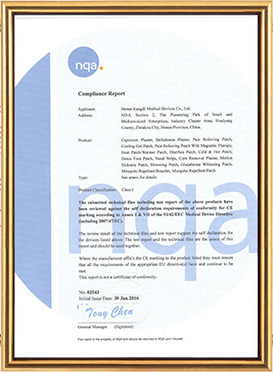
Henan Kongdy Medical Devices Co., LTD. (KONGDY) was founded in 1989 and has 37 years of production experience as of 2026 across pain relief patches, slimming patches, capsicum plasters, heat patches, cooling gel patches, detox foot patches, steam eye masks, mosquito repellent patches and nose strips. Headquartered in Henan, China, KONGDY operates a 100,000-class GMP workshop built in 2008 and obtained ISO 13485 medical device Quality Management System European Standard Certification in 2014. The company runs OEM and ODM services for international brands across multiple regulatory pathways.
For a 2026 procurement evaluation the qualification team can supply the ISO 13485 certificate, GMP workshop audit reports, stability programme documentation, and reference customer case studies upon request via our contact page.
Related Guides
Five further references from the KONGDY knowledge base:
- Detox Foot Patch OEM: the 20-point change control checklist
- Pain Relief Patch OEM: six warning letters compared
- Frequently asked compliance questions
- KONGDY OEM and ODM manufacturing services
- Nose Strip OEM: three enforcement routes compared


