
-
 KONGDY
FDA Warning Letter 736006 to Amazon: What a Cooling Gel Patch OEM Should Learn About Marketplace Responsibility and Monograph Boundaries
FDA Warning Letter 736006 to Amazon: What a Cooling Gel Patch OEM Should Learn About Marketplace Responsibility and Monograph Boundaries

On 1 October 2026 the Center for Drug Evaluation and Research issued warning letter MARCS-CMS 736006. It is addressed to Andy Jassy as chief executive of Amazon.com, Inc., at P.O. Box 81226, Seattle, and it is about nine products sold on amazon.com.
The letter matters to a patch manufacturer for three reasons, and none of them is the obvious one.
The first is that FDA bought the products in July 2026 and issued the letter three months later, without visiting any facility. The second is that the responsibility chain runs through the fulfilment service, which handles picking, packing, shipping, customer service and returns on behalf of third parties. The third is a footnote that states, more precisely than any guidance document does, exactly what the over-the-counter monograph for external analgesics does and does not permit.
For a cooling gel patch OEM the value of reading this letter carefully is that it separates three things that are usually discussed as one. A claim, a monograph category and a regulatory route are three different questions, and the letter treats them separately.
One more detail is worth flagging before the analysis. One of the nine products named, Terragen HG Formula, also appears in a different warning letter in this library, addressed to the firm that makes it. The same product reached two different recipients through two different routes, which is the clearest available illustration of what a marketplace letter does.
1. The facts, exactly as the letter states them
The letter is short and specific, and the facts below are everything it establishes about how it came to be written.
| Item | What the letter states |
|---|---|
| Letter | MARCS-CMS 736006, dated 1 October 2026 |
| Issuing office | Center for Drug Evaluation and Research, CDER |
| Recipient | Andy Jassy, CEO, Amazon.com, Inc., P.O. Box 81226, Seattle, WA 98108-1226, United States |
| Delivery | By electronic mail, with read receipt requested |
| Product category | Drugs, over-the-counter drugs |
| How the finding arose | FDA reviewed drug products purchased on www.amazon.com, bought in July 2026, and reviewed the product labelling |
| Products named | FemiClear, HClear for him, HerpCare Ointment, HerpCare Spray, Herstat GST, Genital Herpes Ointment, RoyceDerm Herpes Relief Cream, Terragen HG Formula, Genital Herpes Intimate Wash |
| Response required | Within fifteen business days of receipt, to FDAAdvisory@fda.hhs.gov, with reference number 736006 in the subject line |
| Signature | Tina Smith, M.S., Captain, U.S. Public Health Service, Director, Office of Unapproved Drugs and Labeling Compliance, CDER |
| Published | The letter closes by stating that FDA posts warning letters on www.fda.gov |
Two rows in that table carry more weight than they look. The fourth establishes that no site visit took place, which is the subject of the second section. The sixth establishes that the evidence was obtained by buying the product, which means the evidence is the listing itself.
2. The finding arose without an inspection
FDA bought nine products through the website in July 2026 and issued the letter on 1 October 2026, which is roughly three months and involves no facility at all.
| Route to a letter | What it requires of the agency | The example in this library |
|---|---|---|
| Site inspection | Investigators travel to the facility, observe, and issue a Form FDA 483 | Macau-Union: inspected 15 to 17 December 2025, letter 29 May 2026, about 5.4 months |
| Site inspection, second example | Same route | 320-26-99: inspected 9 to 19 December 2025, letter 2 July 2026, about 6.4 months |
| Purchase and label review | Purchase the product, read the listing, and apply the statute to the claims | MACRS-CMS 736006: purchased July 2026, letter 1 October 2026, about three months |
| Website and storefront review | Read the firm website and its storefront | MACRS-CMS 735346: reviewed July 2026, letter 1 October 2026 |
The comparison is uncomfortable for anyone who thinks of compliance as a factory question. The inspection route takes roughly five and a half to six and a half months from the visit to the letter. The purchase route takes roughly three, and it does not require the firm to own a building.
For a cooling gel patch OEM the practical consequence is that the listing is not a commercial artefact sitting downstream of the file. It is a piece of evidence, and it is the piece the agency reaches for first when it chooses the cheaper route. A cooling gel patch OEM that treats the listing as downstream of the file has the order reversed, and a cooling gel patch OEM that owns the copy has nothing to reverse.
3. What the claims actually said
The letter quotes the labelling at length, and the pattern across the nine products is consistent enough to be instructive.
| Product | A quoted claim |
|---|---|
| FemiClear | Fast-acting ointment for recurring outbreak symptoms, and intended to relieve symptoms associated with diagnosed genital herpes, including itching, burning and pain |
| HClear for him | Fast-acting outbreak symptom relief for itching, tingling, pain and burning |
| HerpCare Ointment | Purpose stated as anti-fungal and anti-microbial, with temporary relief from skin inflammation, irritation and tingling caused by genital herpes |
| HerpCare Spray | Relief on the go, and soothes irritation, burning and itching quickly |
| Genital Herpes Intimate Wash | Antiviral action to reduce viral activity, pain relief by targeting nerve endings, anti-inflammatory, and healing support |
| Herstat GST | Genital sore treatment, soothes and calms genital sores, relieves pain and itching associated with genital sores |
| RoyceDerm Herpes Relief Cream | Fights outbreaks, soothes and cools, and reduces recurrence |
| Terragen HG Formula | Relief of swelling and pain associated with genital sores |
The eighth row is the one that connects this letter to another one in the library. Terragen HG Formula also appears in MACRS-CMS 735346, addressed to Aidance Scientific, which is the firm that makes it. The same product produced a letter to the maker and a letter to the seller, and the two letters are about the same wording on the same label.
That is the whole structure of a marketplace finding in one sentence. The claim belongs to the product, and the responsibility for displaying it is shared, which is why a cooling gel patch OEM that sells through a platform should read the letter as a statement about its own listing copy. That is why a cooling gel patch OEM should own the copy rather than approve it after the fact.

4. The first route: an unapproved new drug
All nine products were found to be unapproved new drugs, and the reasoning runs through four statutory definitions in sequence.
| Step in the reasoning | The provision | What it establishes |
|---|---|---|
| The products are drugs | 21 U.S.C. 321(g)(1), the FD&C Act definition | Articles intended for use in the diagnosis, cure, mitigation, treatment or prevention of disease, or intended to affect the structure or function of the body |
| Their intended use is taken from the label | 21 CFR 201.128 | The claims quoted above are the evidence of intended use |
| They are new drugs | 21 U.S.C. 321(p) | Not generally recognised as safe and effective for use under the conditions in their labelling |
| No approved application is in effect | 21 U.S.C. 355(a), the FD&C Act section 505(a) | Introducing or delivering them for introduction into interstate commerce violates 21 U.S.C. 331(d) and 355(a) |
The third row is the one that does the work, and it is worth stating plainly. A product is a new drug not because it is new but because it is not generally recognised as safe and effective for the use its own labelling recommends. The claim creates the condition.
The letter also makes a public health statement that a manufacturer should read as the reason the agency moved quickly. It states that FDA has not approved any over-the-counter drug product for the treatment, cure, mitigation or prevention of any sexually transmitted infection, and that people who rely on such products may forgo timely and appropriate medical care. A cooling gel patch OEM reading that paragraph should notice that the urgency came from the claim rather than from the factory.

5. The second route: the monograph footnote
One product failed on a narrower ground, and the footnote that says so is the most precise statement of the monograph boundary in this library.
The footnote is about Herstat GST. It sets out what the over-the-counter monograph M017, External Analgesic Drug Products for Over-the-Counter Human Use, actually permits, and then applies it.
| M017 permits | Herstat GST claimed | Result |
|---|---|---|
| Treatment of pain generally | Genital sore treatment | Within the general permission if read alone |
| Treatment of itching generally | Relieves pain and itching associated with genital sores | Within the general permission if read alone |
| Treatment of minor skin irritation generally | Soothes and calms genital sores | Within the general permission if read alone |
| Prevention of premature ejaculation | Not claimed for this product | Not the basis of the finding |
| The permitted indications do not extend to the condition claimed here | Relief from genital sores and their associated symptoms | Goes beyond the permissible indications, so the product does not conform to M017 or any other final OTC administrative order |
The letter draws the conclusion explicitly: because Herstat GST does not conform to M017 or any other final order, there is no basis under section 505G of the FD&C Act on which it could be legally marketed without an approved application.
Two things about that reasoning are worth carrying into a cooling gel patch OEM programme. The first is that the monograph is a list of indications, not a list of ingredients alone, so a permitted ingredient can still sit inside an impermissible claim. The second is that the fourth row is real: the monograph genuinely includes the prevention of premature ejaculation, which is not a phrase anyone would invent. A cooling gel patch OEM that has read the permitted indications once has read them for every product it makes.

6. The third route: homeopathic labelling is not an exemption
Several of the products were labelled as homeopathic, and the letter deals with that directly rather than by omission.
Its wording is short and unambiguous. Terragen HG Formula is labelled as a homeopathic drug with active ingredients measured in homeopathic strengths. The letter acknowledges that the term drug includes articles recognised in the official Homeopathic Pharmacopeia of the United States, and then states that homeopathic drug products are subject to the same statutory requirements as other drugs, and that nothing in the FD&C Act exempts them from any requirement relating to adulteration, misbranding or FDA approval.
| What the letter says about homeopathy | What it means for a manufacturer |
|---|---|
| Articles recognised in the Homeopathic Pharmacopeia are drugs | The label does not move the product outside the statute |
| Homeopathic products carry the same statutory requirements | Adulteration, misbranding and approval all still apply |
| Nothing exempts them from those requirements | There is no homeopathic route that replaces an application |
| FDA issued guidance in December 2022 on enforcement priorities for higher-risk homeopathic products | The category is subject to a published enforcement policy rather than to tolerance |
The fourth row is the one a supplier is most likely to be surprised by, because it is a dated document that most people have never read. FDA issued the homeopathic drug products guidance in December 2022, and it describes how the agency intends to prioritise enforcement for categories of homeopathic products that potentially pose a higher risk to public health.
For a cooling gel patch OEM the lesson is not about homeopathy specifically. It is that a labelling tradition is a statement about how a product was formulated, not a statement about which framework applies. A cooling gel patch OEM on the cosmetic route makes the same distinction every time it describes a botanical.

7. The responsibility chain through the fulfilment service
The most commercially significant part of the letter is a footnote, and it is about who handled the goods.
The footnote states that the products were introduced or delivered for introduction into interstate commerce by the company through its fulfilment service, and that the company distributed each of the products directly to individual United States consumers on behalf of third parties.
| What the footnote establishes | Why it matters to the seller |
|---|---|
| The products were fulfilled by the company | The platform was not only displaying a listing |
| The company distributed them directly to individual consumers | The goods moved through the platform to the buyer |
| The distribution was on behalf of third parties | The seller of record may be someone else, and the obligation still attached to the platform |
| The service handles picking, packing, shipping, customer service and returns | The platform is inside the transaction from warehouse to complaint |
The fourth row is the part that makes the finding hard to argue with, and the letter sources it to the platform own public description of the service rather than to an inference. Once the platform is picking, packing, shipping and handling returns, it is not a noticeboard.
The consequence for a cooling gel patch OEM is that the choice of fulfilment model changes the set of parties who can be named. A seller that ships itself is the only party in the chain. A seller that uses a platform fulfilment service is one of two, and the other one has a legal department. A cooling gel patch OEM should therefore record the fulfilment party per market rather than describing distribution in general terms.
8. What this letter does and does not establish
A warning letter is an enforcement document, and reading it as more than that produces conclusions the text will not support.
| The letter establishes | The letter does not establish |
|---|---|
| Nine named products were unapproved new drugs as labelled | That any of them injured a consumer |
| The claims quoted above were observed on the labelling | That the manufacturer intended those claims, as distinct from the seller |
| One product did not conform to the external analgesic monograph | That every ingredient in it was prohibited |
| Homeopathic labelling does not exempt a product from the statute | That homeopathic products are prohibited |
| A response was required within fifteen business days | That any enforcement action beyond the letter has occurred |
The third row of the second column is worth stating precisely, because it is the one most often overstated in summaries. The finding is that the product does not conform to the monograph because its claimed indication sits outside the permitted ones. That is a statement about the claim and the category, and it is narrower than a statement about the formula. A cooling gel patch OEM reading only the summary would conclude the opposite.

9. Six checks a buyer can run on a claim set
Everything above reduces to six questions, and each one can be answered from documents rather than from assurances.
- Which framework does each claim sit in? The letter takes intended use from the label under 21 CFR 201.128, so the claim is the first fact to establish rather than the last.
- Does the claim sit inside a permitted indication, not just inside a permitted ingredient list? Herstat GST is the worked example: the indication was the problem, not the substance.
- Is the claim identical everywhere it appears? The letter quotes product labelling sold on a website, which means every listing is a version of the label and every version is evidence.
- Does the labelling tradition carry a framework with it? Homeopathic labelling did not, and the December 2022 guidance describes how the agency prioritises that category.
- Who handles the goods? The fulfilment footnote is the reason a platform can be named alongside a seller, so the answer belongs in the file.
- What did the file say the claim was, on what date? A dated claim record is the only document that shows the claim was reviewed rather than inherited.
The sixth point is the one that costs least and is missing most often. A cooling gel patch OEM with a dated claim record can show what it believed on a specific day, and one without it can only show what it believes today. A cooling gel patch OEM that answers all six from documents has answered the letter before receiving one.

10. What to write into the contract
Five clauses, each derived from a specific finding in the letter.
| Clause | What it should say | The finding behind it |
|---|---|---|
| Claim approval | No claim may be used in any channel without a written determination that it sits inside the applicable permitted indications, and the determination must name the framework | The monograph finding rests on an indication, not on an ingredient |
| Channel parity | Every listing, marketplace page and advertisement must match the approved claim block, and the seller is responsible for distributor copy | The evidence was the labelling as sold on a website |
| Framework declaration | The supplier states in writing which framework the product is marketed under, and does not rely on a labelling tradition as evidence of route | The homeopathic label did not create an exemption |
| Fulfilment disclosure | The supplier discloses which party handles fulfilment, storage and returns for each market | The responsibility chain in the letter runs through the fulfilment service |
| Response undertaking | Written notice of any regulatory action within a stated period, with the filing produced on request | The letter set a fifteen business day response window |
The second clause is the one that will be resisted, because distributors usually want to write their own copy. The letter is the argument against conceding that, and it is a public one. A cooling gel patch OEM can cite it directly rather than arguing from principle.
11. Why this letter is worth more than its subject
The letter is about nine products in one therapeutic area, and its value to a patch manufacturer lies in the three distinctions it draws cleanly.
| The distinction | What the letter shows |
|---|---|
| A claim versus a formulation | The monograph finding concerns the indication claimed, not an ingredient |
| A labelling tradition versus a regulatory route | Homeopathic labelling carried the statute with it rather than replacing it |
| A seller versus a party to the transaction | The fulfilment service handling the goods put the platform inside the chain |
Those three distinctions do not depend on the products involved. They apply to a warming patch, a cooling patch and anything else with a claim on a pack.
The last thing worth noting is how the letter compares with the European record in the same library, because the two systems find products in different ways. In the Safety Gate 2025 report, chemical risk accounted for 53 percent of all notifications and almost eight in ten cosmetics alerts involved a single banned fragrance, which is a substance-based finding. This letter is a claim-based finding. A cooling gel patch OEM selling into both markets is exposed to both, and the two are answered with different documents.
About KONGDY Medical

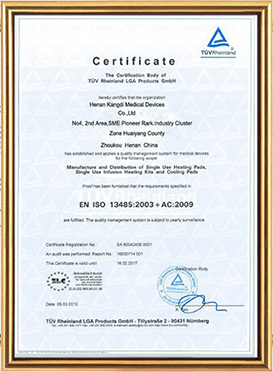
Henan Kongdy Medical Devices Co., LTD. (KONGDY) was founded in 1989 and has 37 years of production experience as of 2026 across pain relief patches, slimming patches, capsicum plasters, heat patches, cooling gel patches, detox foot patches, steam eye masks, mosquito repellent patches and nose strips. Headquartered in Henan, China, KONGDY operates a 100,000-class GMP workshop built in 2008 and obtained ISO 13485 medical device Quality Management System European Standard Certification in 2014. The company runs OEM and ODM services for international brands across multiple regulatory pathways.
For a 2026 procurement evaluation the qualification team can supply the ISO 13485 certificate, GMP workshop audit reports, stability programme documentation, and reference customer case studies upon request via our contact page.
Frequently asked questions
What is warning letter MARCS-CMS 736006 about?
It is a warning letter dated 1 October 2026 from the Center for Drug Evaluation and Research to Amazon.com, Inc., concerning nine products sold on amazon.com that FDA found to be unapproved new drugs. The letter names FemiClear, HClear for him, HerpCare Ointment, HerpCare Spray, Herstat GST, Genital Herpes Ointment, RoyceDerm Herpes Relief Cream, Terragen HG Formula and Genital Herpes Intimate Wash.
Why did a platform receive the letter rather than only the sellers?
Because the letter states that the products were introduced or delivered for introduction into interstate commerce by the company through its fulfilment service, and that it distributed them directly to individual consumers on behalf of third parties. The footnote cites the platform own description of that service, which covers picking, packing, shipping, customer service and returns.
Was there an inspection?
No. The letter states that the finding arose from a review of drug products purchased on the website in July 2026. The letter is dated 1 October 2026, so the interval from purchase to letter is roughly three months, against roughly five and a half to six and a half months for the inspection-based letters in the same library.
What does the monograph footnote actually say?
It states that the permitted indications under OTC Monograph M017, External Analgesic Drug Products for Over-the-Counter Human Use, cover the treatment of pain, itching and minor skin irritation generally, and the prevention of premature ejaculation. It then finds that Herstat GST is intended to relieve genital sores and their symptoms, which goes beyond those indications, so the product does not conform to M017 or any other final order and there is no basis under section 505G for marketing it without an approved application.
Does homeopathic labelling change the analysis?
No, and the letter says so directly. It acknowledges that the term drug includes articles recognised in the Homeopathic Pharmacopeia of the United States, and then states that homeopathic drug products are subject to the same statutory requirements as other drugs, with nothing in the FD&C Act exempting them from the requirements on adulteration, misbranding or FDA approval.
Is this the only letter in this library that names Terragen HG Formula?
No. It also appears in MACRS-CMS 735346, addressed to Aidance Scientific, which is the firm that makes it. One product, two recipients, two letters, which is the clearest illustration of how a marketplace finding differs from a manufacturer finding.
How long did the company have to respond?
Fifteen business days from receipt, by email to FDAAdvisory@fda.hhs.gov, with the reference number 736006 in the subject line. The letter also asks for the specific steps taken, an explanation of each step intended to prevent recurrence, and copies of related documentation.
What should a patch manufacturer take from this letter?
Three things. A claim is the fact that decides the framework, so the claim record matters as much as the formula record. A labelling tradition does not change which framework applies. And the fulfilment model changes which parties can be named, which belongs in the file rather than in the commercial conversation.
Related Guides
Five further references from the KONGDY knowledge base:
- Pain Relief Patch OEM: the warning letter lifecycle
- Capsicum Plaster OEM: substance family screen
- Frequently asked compliance questions
- KONGDY OEM and ODM manufacturing services
- Heat Patch OEM: heat output and classification


