
-
 KONGDY
From Form 483 to Close-Out: 12 Questions a Pain Relief Patch OEM Buyer Should Ask About a Warning Letter in 2026
From Form 483 to Close-Out: 12 Questions a Pain Relief Patch OEM Buyer Should Ask About a Warning Letter in 2026
In fiscal year 2025 the United States Food and Drug Administration issued 303 warning letters to drug and biological product manufacturers, against 190 in fiscal year 2024, an increase of 59 percent, and the agency shortened its issuance cycle by roughly a third.
A buyer reading those numbers usually asks the wrong question, which is whether a supplier has ever received one. The more useful question is what stage of the process a supplier is at, because a warning letter is not an event. It is a stage.
The process starts with something that produces a finding, moves through a written response, becomes a published letter, and ends with a close-out or does not end at all. Each of those stages produces a different document, and each document tells a buyer something different about the supplier.
A pain relief patch OEM selling into the United States sits inside this process whether or not it has been through it yet, because the route that makes a patch a drug in the United States also makes it subject to these inspections. The twelve questions below are the ones worth asking, in the order the process actually runs.
Two of the facts below are new in this article and are worth flagging at the start. The first is that enforcement without a site inspection is faster than enforcement after one, and the interval is measurable from the public dates. The second is a specific boundary in the over-the-counter monograph for external analgesics, which was published in a warning letter footnote in October 2026 and is more precise than anything in the guidance itself.
1. What starts the process?
Either a site inspection or a review of what the market is selling, and the two lead to the same outcome by different routes.
A site inspection is the familiar route. Investigators visit, observe, and issue a Form FDA 483 listing what they saw. The Macau-Union case in this library records an inspection from 15 to 17 December 2025, a response to the Form FDA 483 dated 2 February 2026, and a warning letter dated 29 May 2026.
The other route does not involve a visit at all, and a buyer should understand it because it is the faster one. In the Amazon case, FDA bought the products on the website in July 2026 and issued the letter on 1 October 2026. In the Aidance case the agency reviewed the firm website and its storefront in July 2026 and issued the letter on the same date. Neither letter followed an inspection.
| Route | What produces the finding | The public dates in this library |
|---|---|---|
| Site inspection | Investigators observe the facility and issue a Form FDA 483 | Macau-Union: inspection 15 to 17 December 2025; 483 response 2 February 2026; letter 29 May 2026 |
| Inspection, second example | Same route, different firm | 320-26-99: inspection 9 to 19 December 2025; letter 2 July 2026 |
| Inspection, third example | Same route, different firm | 320-26-105: inspection 12 to 16 January 2026; letter 24 July 2026 |
| Online review without a visit | FDA reviews a website or buys the product and reads the label | Amazon: products purchased July 2026; letter 1 October 2026 |
| Online review, seller side | FDA reviews the firm website and storefront | Aidance: review July 2026; letter 1 October 2026 |
The last two rows are the reason a pain relief patch OEM cannot treat this as a factory question. Nothing in the online route requires the firm to have a facility at all.
For a pain relief patch OEM the second route is the one that arrives without warning, because it needs no visit and no appointment.
2. How long does it take?
Roughly five and a half to six and a half months after a site inspection, and roughly two and a half to three months after an online review, measured from the public dates.
| Case | Start date | Letter date | Elapsed |
|---|---|---|---|
| 320-26-12 | Inspection ended 9 May 2025 | 31 October 2025 | About 5.7 months |
| 724506 | Inspection ended 17 December 2025 | 29 May 2026 | About 5.4 months |
| 320-26-99 | Inspection ended 19 December 2025 | 2 July 2026 | About 6.4 months |
| 320-26-105 | Inspection ended 16 January 2026 | 24 July 2026 | About 6.2 months |
| 735346 | Website review July 2026 | 1 October 2026 | About 2.5 to 3 months |
| 736006 | Products purchased July 2026 | 1 October 2026 | About 2.5 to 3 months |
The last two rows carry a caveat and it is worth stating rather than hiding. The online cases record a month rather than a day, so the interval can only be given as a range. The inspection cases record exact dates, which is why their intervals are given to one decimal place.
The practical consequence for a buyer is uncomfortable. A pain relief patch OEM that says it has never received a warning letter is reporting the absence of a published letter, and a published letter can be five or six months behind the inspection that produced it. Silence in the register is evidence about the register.
A pain relief patch OEM that knows its own intervals can answer a buyer precisely, and one that has never computed them can only say that nothing has happened yet.

3. What is a Form FDA 483, and is it public?
It is the list of observations issued at the end of an inspection, and it is not published in the warning letter database.
The distinction matters because a buyer who only searches the public warning letter list is searching the wrong register for the earliest signal. A Form FDA 483 is given to the firm, and the firm answers it. Only if the agency decides the answer is inadequate, or the findings are serious enough, does the matter become a warning letter, at which point it is published.
The Macau-Union case shows the chain in one line. The inspection was from 15 to 17 December 2025, the Form FDA 483 response was dated 2 February 2026, and the letter stated that FDA had reviewed that response in detail. The published document is the letter, and the 483 sits behind it.
That creates a specific question a buyer can ask a supplier, and it is a better question than the public register search: have you received any Form FDA 483 in the last three years, and can I see the response you filed to it.
A pain relief patch OEM that answers that with a document has answered the question the register cannot.

4. How long does the firm have to respond?
It depends on which kind of letter it is. The online-review letters in this library state fifteen business days, and the inspection letters do not state a single universal period in the published text.
| What the letter says | Where it appears | What it means for a buyer |
|---|---|---|
| Fifteen business days from receipt | MACRS-CMS 736006, with the response address FDAAdvisory@fda.hhs.gov and the reference number 736006 required in the subject line | A firm that has received one of these letters has a date, and the date is short |
| A response to the Form FDA 483 before the letter | MACRS-CMS 724506, where the 483 response was dated 2 February 2026 and the letter of 29 May 2026 states that it was reviewed in detail | The 483 response is a document that exists whether or not the letter follows |
| A list of specific items the agency wants supplied | MACRS-CMS 724506, which sets out the items under each of its four findings | The letter is effectively a specification of what a compliant file would have contained |
The third row is the part a buyer can use commercially. A warning letter is unusual among regulatory documents in that it says, in public, exactly what the agency would have wanted to see. A pain relief patch OEM that has the same items in its own file is not relying on a hope.
5. What does it mean when FDA says a response was inadequate?
It means the response described corrective actions without providing the documentation behind them, and it is the most repeatable failure in this library.
The Macau-Union letter rejected the response on four separate findings, and the wording is consistent each time. On release testing, the response committed to testing identity, assay, microbial limits and critical quality attributes and supplied summary test reports, and the letter says it was inadequate because there was no supporting documentation for the corrective actions, no specifications attached to the analytical reports, and no scientific justification for the finding that the active ingredients were below the labelled concentration.
| What the firm wrote | What the letter said was missing |
|---|---|
| A commitment to test identity, assay and microbial limits | Supporting documentation for the corrective actions, and specifications attached to the reports |
| Summary test reports for shipped batches | A scientific justification for the result that the actives were below the labelled concentration |
| Microbiological results citing modified pharmacopeial methods | A description of the modifications and validation data for them |
| A commitment to a stability programme | A risk assessment for the products already on the market, and interim measures during implementation |
The lesson transfers directly to how a buyer reads a supplier response. A corrective action statement without a record is what the agency rejected, and it is also what a supplier will show a buyer when the buyer asks how a problem was fixed.
6. Is the letter published, and when?
Yes, and FDA states so in the letter itself. The Amazon letter closes with the sentence that FDA posts warning letters on www.fda.gov.
The delay between issue and posting is short and it is visible in the register. The Macau-Union letter is dated 29 May 2026 and appears in the public listing with a posted date of 9 June 2026.
The practical point is that a buyer who checks the register is checking a recent record rather than a historical one. The listing in the FDA warning letters database on 28 October 2026 included entries posted that same day, including letters issued in August and September 2026, which means the published record is current to within weeks rather than quarters.
A pain relief patch OEM can therefore be checked against a record that is weeks old, not one that is years old.
7. Can a letter be closed, and what does close-out mean?
Yes, and FDA maintains a separate register for it, which is the second reason a public search is worth doing properly.
The warning letters database carries an explicit filter for letters with a response or close-out letter, with separate options for response letters, close-out letters, and both. A close-out letter indicates that the agency considered the firm to have addressed the matters in the letter.
What it does not do is remove the original letter from the record, and this is the point a buyer most often misreads. A closed letter is still a published letter. The finding happened, the letter was issued, and the closure records what came after it.
For a pain relief patch OEM the distinction is worth explaining to a customer in the opposite direction from the one that feels comfortable. A closed letter with a documented response is stronger evidence than no letter at all, because it is a record of a system that found a problem, answered it, and was accepted.
A pain relief patch OEM that can show that sequence has shown more than one that can show nothing.

8. What can a buyer actually see for itself?
More than most suppliers assume, and all of it without asking permission.
| What is public | Where it is | What it establishes |
|---|---|---|
| The letter itself | The FDA warning letters database, with an entry per letter | The firm, the issuing office, the subject, the issue date and the posted date |
| The issuing office | On the letter, for example CDER or the Center for Devices and Radiological Health | Which regulatory framework the finding sits in |
| The clauses cited | Inside the letter, for example 21 CFR 211.165(a) and (b) | What the finding was about, at the level of a specific requirement |
| Whether a response or close-out exists | The response and close-out filters on the same database | Whether the matter was addressed after the letter |
| The facility identifier where one is given | Inside the letter, for example FEI 2016148 in the 320-26-99 case | Which site the finding attaches to, which matters for multi-site firms |
The last row is the one that catches multi-site suppliers. A facility identification number belongs to a site rather than to a company, which is why the same corporate group can show one clean site and one with a finding.
A pain relief patch OEM operating several sites should expect the question to be asked per site rather than per company.
9. Does a letter mean the product was unsafe?
Not in the sense a lay reader takes from the word, and the distinction is specific rather than reassuring.
In the Macau-Union case the adulteration finding rests on current good manufacturing practice non-conformity under 21 U.S.C. 351(a)(2)(B), which is a statement about the methods, facilities and controls. The letter itself states that because those do not conform, the products are adulterated within the meaning of that section. It is a legal conclusion about conformance, not a finding that a specific batch injured anyone.
In the Amazon case the finding is different in kind. The letter states that FDA has not approved any over-the-counter drug product for the treatment, cure, mitigation or prevention of any sexually transmitted infection, and that products marketed for that purpose present a serious public health concern because people may forgo timely appropriate medical care. That is a finding about a claim and its consequences, not about a manufacturing defect.
Both matter to a buyer, and they matter in different ways. A manufacturing finding is answered with records. A claim finding is answered with a corrected label, which sounds easier and is usually slower, because it reaches every listing and every distributor.
A pain relief patch OEM selling through marketplaces faces the second kind more often than the first.

10. Can a supplier with a letter still be used?
Yes, and the decision should turn on what stage the matter reached rather than on the existence of the letter.
| The situation | What it tells a buyer | What to ask for |
|---|---|---|
| A letter with no response on record | The matter is live, or the response has not been posted yet | The response that was filed, and its date |
| A letter with a response letter | The firm answered, and the agency has published the exchange | The response itself, and the records it attached |
| A letter with a close-out | The agency considered the matters addressed | The close-out, plus the corrective action record behind it |
| A Form 483 with no letter | Observations were issued and the agency did not escalate, which is itself evidence about the response | The 483 and the response filed to it |
| No public record at all | Nothing about the register, which is not the same as nothing about the firm | Any 483 received in the last three years, and the site identifiers for each facility |
The last row is the one that decides most real decisions, and it is why question three comes before this one. A supplier with no public record may still have a 483, an inspection that found nothing published, or a finding five months from becoming a letter. The register answers a narrower question than the one a buyer is asking.
A pain relief patch OEM that understands the gap can answer the wider question before it is asked. A pain relief patch OEM that only checks the register has checked one of four records.
11. What goes into the contract?
Four clauses, and each one converts a public record into a contractual obligation.
- A notification clause. Written notice of any Form FDA 483, warning letter, inspection, or regulatory action relating to the product, within a stated period of the firm becoming aware of it. The reason is the interval in question two: the gap between the event and the publication is measured in months.
- A records clause. The right to receive the release specification, the batch assay results, the stability protocol and the change log on request. Every one of these was a document FDA asked for in the Macau-Union letter.
- A claim control clause. No claim may be used without a written determination that it sits inside the applicable framework, and the clause must cover marketing copy and marketplace listings rather than only the printed label. The Amazon letter rests entirely on claims observed on labels.
- A close-out clause. Where a letter exists, the supplier warrants that each corrective action has been implemented and provides the record, rather than warranting that a response was sent.
The fourth clause is the one that a supplier will resist, and it is also the one that separates the two situations the agency itself distinguished in the Macau-Union letter, which are a response that committed to corrective actions and a response that documented them.
A pain relief patch OEM that signs the fourth clause has agreed to be judged on records rather than on intentions. A pain relief patch OEM whose customer asks for the first three and not the fourth has been asked for a letter rather than a system.

12. How do you keep watching without doing it manually?
Three registers, checked on a cycle, because the public record is spread across more than one place.
| What to watch | How often | Why that frequency |
|---|---|---|
| The warning letters database, filtered by the firm and by the issuing office | Monthly | The published record runs to within weeks, and the issuance cycle has been shortened by about a third |
| The response and close-out filters for any letter already known | Monthly | A close-out changes the status of a matter a buyer has already assessed |
| The weekly EU Safety Gate panel, for European sales | Weekly | It is published continuously at close to 100 validated notifications a week, and it names products rather than firms |
| The Form FDA 483 question, asked directly of the supplier | At each annual review | It is the only route to the stage before publication |
The third row is included deliberately, because a pain relief patch OEM selling into both markets has two registers to read and they measure different things. The United States register is organised by letter and names a firm. The European panel is organised by notification and names a product. Neither substitutes for the other.
The whole of this article reduces to one sentence about scheduling. The register is current, the inspection behind it is months older, and the 483 behind that is older still. A buyer who plans the check rather than reacting to it is reading the process. A buyer who reacts is reading the archive.

About KONGDY Medical

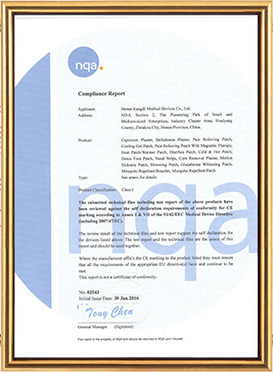
Henan Kongdy Medical Devices Co., LTD. (KONGDY) was founded in 1989 and has 37 years of production experience as of 2026 across pain relief patches, slimming patches, capsicum plasters, heat patches, cooling gel patches, detox foot patches, steam eye masks, mosquito repellent patches and nose strips. Headquartered in Henan, China, KONGDY operates a 100,000-class GMP workshop built in 2008 and obtained ISO 13485 medical device Quality Management System European Standard Certification in 2014. The company runs OEM and ODM services for international brands across multiple regulatory pathways.
For a 2026 procurement evaluation the qualification team can supply the ISO 13485 certificate, GMP workshop audit reports, stability programme documentation, and reference customer case studies upon request via our contact page.
Related Guides
Five further references from the KONGDY knowledge base:
- Cooling Gel Patch OEM: regulatory categories and stability evidence
- Capsicum Plaster OEM: pre-contract checklist
- Frequently asked compliance questions
- KONGDY OEM and ODM manufacturing services
- Heat Patch OEM: heat output and classification


